



February 27, 2026
The U.S. Court of Appeals for the Fifth Circuit ruled that the FDA complied with the requirements of the Regulatory Flexibility Act when issuing its 2021 final PMTA rule, and that the agency could rely on the cost analysis from its 2016 deeming rule as a factual basis for concluding that the rule’s impact on small businesses would be minimal.
Key Points
- The U.S. Fifth Circuit upheld the FDA’s position, finding that the agency complied with legal requirements in issuing the 2021 final PMTA rule.
- The court said the FDA satisfied its procedural obligations under the Regulatory Flexibility Act (RFA) and could reasonably rely on the 2016 deeming rule’s economic analysis to support its conclusion that the impact on small businesses was minimal.
- The plaintiffs were a group of e-liquid manufacturers and industry organizations, who argued that the rule imposed overly burdensome requirements and that less restrictive alternatives should have been considered.
- The court noted that many of the PMTA requirements—especially the submission of information on product health risks and benefits—are mandated by statute, meaning the FDA cannot waive them through regulation.
2Firsts, February 27, 2026
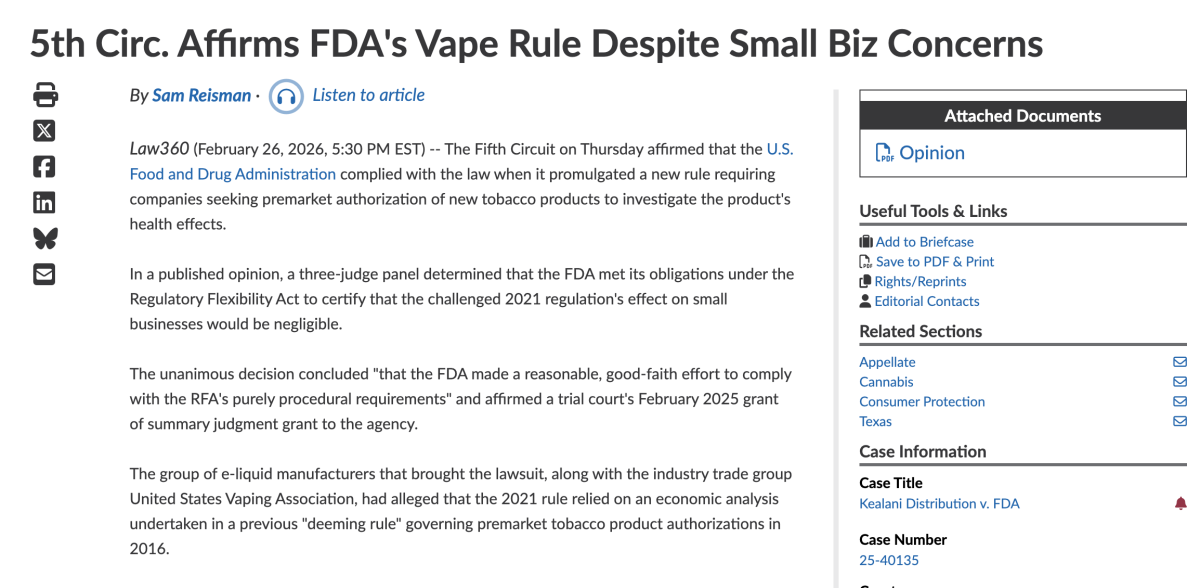
According to Law360, the U.S. Court of Appeals for the Fifth Circuit ruled that the U.S. Food and Drug Administration (FDA) acted lawfully when it issued its 2021 rule requiring new tobacco product applicants to investigate and submit information regarding the health impacts of their products as part of the premarket tobacco product application (PMTA) process.
In a published opinion, the court found that the FDA had fulfilled its obligations under the Regulatory Flexibility Act (RFA) and had reasonably demonstrated that the 2021 regulatory measure would not have a significant economic impact on a substantial number of small entities.
The panel unanimously concluded that the FDA had made a “reasonable and good-faith” procedural effort to comply with the RFA, and it affirmed the lower court’s summary judgment in favor of the FDA issued in February 2025.
The plaintiffs included several e-liquid manufacturers as well as the United States Vaping Association.
The plaintiffs argued that the 2021 rule relied on the economic analysis of PMTA compliance costs that had originally been developed in the FDA’s 2016 Deeming Rule.
In response, the court held that the 2016 rule’s assessment of compliance costs provided a sufficient factual basis for the FDA’s certification that the 2021 final PMTA rule would not have a significant economic impact on a substantial number of small entities.
The plaintiffs also argued that the FDA failed to consider less burdensome alternatives.
However, the court stated that some of the requirements challenged as overly burdensome in the 2021 rule—particularly the obligation for applicants to submit information about the potential harms and benefits of their products—are actually required by the Tobacco Control Act and therefore are statutory mandates.
The court wrote that the requirement for applicants to submit all known investigations concerning the health risks of their products in a PMTA is “required by law”, and that this obligation was imposed by Congress rather than by the FDA. As a result, the FDA cannot use regulation to exempt applicants from congressionally mandated requirements.
The lawsuit was filed in October 2022. The plaintiffs said that many companies in the industry had spent significant sums attempting to meet FDA requirements, only to have their applications denied. They had also sought an injunction to block the FDA from enforcing the rule, but that request was unsuccessful.
The case is Kealani Distribution LLC et al. v. Food & Drug Administration et al., case number 25-40135.
Image source: Law360